
Sakrete High Strength Concrete Mix Instructions: A Comprehensive Guide
This guide details using Sakrete for projects, referencing YouTube resources for visual aid and efficient recipes, alongside troubleshooting and technical specifications.
Understanding Sakrete High Strength Concrete Mix
Sakrete High Strength Concrete Mix is a prepackaged blend designed for demanding applications requiring superior durability and load-bearing capacity. It’s a convenient alternative to on-site mixing, ensuring consistent quality. Resources like YouTube offer helpful tutorials demonstrating proper usage and troubleshooting. Understanding the mix’s composition – cement, sand, and gravel – is crucial for successful projects.
Efficient recipes, similar to those found for other mixes, emphasize precise ingredient ratios. While not directly applicable to concrete, the principle of optimized formulas applies. YouTube’s “Stats for nerds” can inform project planning, mirroring data analysis for optimal results. This mix excels in projects needing lasting strength, like footings and structural elements.
What is Sakrete High Strength Concrete Mix?

Sakrete High Strength Concrete Mix is a preblended hydraulic cement, meticulously formulated with carefully graded aggregates, offering exceptional compressive strength. Unlike standard mixes, it’s engineered for projects demanding robust performance, such as foundations, columns, and heavily loaded slabs. YouTube’s content creators often demonstrate its application in various construction scenarios, providing visual guidance.
It simplifies construction by eliminating on-site proportioning, ensuring consistent results. Think of it like following a precise recipe – akin to “BluAmp” mixes – for predictable outcomes. Understanding its composition is key, and resources like YouTube’s help videos can clarify any doubts regarding its properties and uses.
Key Advantages of Using High Strength Concrete
Employing Sakrete High Strength Concrete delivers numerous benefits, notably increased durability and load-bearing capacity, crucial for long-lasting structures. It minimizes cracking and shrinkage, reducing maintenance needs – a feature appreciated when comparing “efficient recipes” for construction projects. YouTube tutorials showcase how this translates to superior project outcomes.
Furthermore, high strength concrete offers enhanced resistance to environmental factors, extending the lifespan of your work. Like mastering “Top Secret Recipes” for consistent results, using this mix ensures predictable performance. Its reduced permeability also protects reinforcing steel from corrosion, contributing to structural integrity, as demonstrated in various online guides.

Preparation Before You Begin
Prior to mixing, gather necessary tools and materials, and crucially, review all safety precautions to ensure a secure and successful concrete project.
Tools and Materials Needed
For successful Sakrete High Strength Concrete Mix application, essential tools include a wheelbarrow or concrete mixer, shovel, measuring bucket, and appropriate safety gear like gloves and eye protection.
You’ll also require a source of clean water, a trowel for smoothing, and potentially a float for finishing. Depending on the project, forms may be needed to contain the concrete while it sets.
Consider a concrete saw for cutting, and brushes for texturing. Access to YouTube tutorials can visually demonstrate proper tool usage, enhancing project efficiency and quality.
Safety Precautions
Working with Sakrete High Strength Concrete Mix requires strict safety adherence. Always wear appropriate personal protective equipment (PPE), including heavy-duty gloves, safety glasses, and a dust mask to prevent skin and eye irritation, and inhalation of cement particles.
Concrete is caustic; avoid direct skin contact. Work in a well-ventilated area.
Be mindful of lifting heavy bags – use proper lifting techniques to avoid injury. Review YouTube safety videos for demonstrations of best practices. Keep children and pets away from the work area.

Mixing Instructions: Step-by-Step
Achieving optimal strength relies on precise mixing; carefully follow water ratio guidelines, whether mixing manually or utilizing a concrete mixer for consistency.
Determining the Correct Water Ratio
Establishing the proper water-to-mix ratio is paramount for Sakrete High Strength Concrete Mix, directly impacting its final strength and durability. Too little water results in a dry, unworkable mix, hindering proper hydration and strength development. Conversely, excessive water weakens the concrete, leading to reduced compressive strength and increased shrinkage.
Always refer to the packaging instructions as a starting point, but consider environmental factors like temperature and humidity. Hot, dry conditions may necessitate slightly more water, while cooler, humid environments may require less. Begin by adding water gradually, mixing thoroughly after each addition, until a consistent, workable consistency is achieved – similar to that of thick oatmeal.
Mixing by Hand
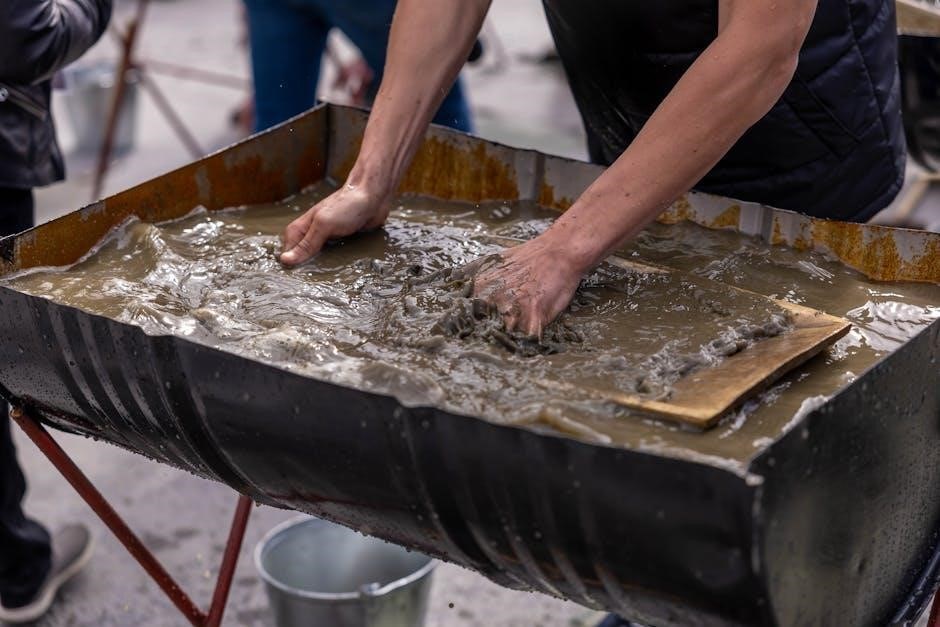
While a concrete mixer is recommended for larger projects, Sakrete High Strength Concrete Mix can be effectively mixed by hand for smaller applications. Begin in a wheelbarrow or on a clean, hard surface. Gradually add the pre-measured water to the dry mix, using a shovel or hoe to thoroughly combine the ingredients.
Ensure all dry powder is incorporated, breaking up any clumps. This requires consistent effort and a chopping motion. Continue mixing for several minutes until a uniform, workable consistency is achieved. Be prepared for a strenuous workout – hand mixing is physically demanding!
Mixing with a Concrete Mixer
For larger projects, a concrete mixer significantly eases the process. Add approximately half the required water into the rotating drum, then slowly add the Sakrete High Strength Concrete Mix. Continue adding the remaining water gradually, observing the mix’s consistency.
Allow the mixer to run for 3-5 minutes, ensuring all ingredients are thoroughly blended. Avoid overwatering, as this weakens the concrete. Periodically stop the mixer and scrape down the sides to ensure even mixing. A properly mixed batch will be homogenous and workable, ready for application.

Application Techniques
Proper pouring and leveling are crucial for structural integrity; consider smoothing or texturing for desired aesthetics, referencing online guides for best practices.
Pouring and Leveling
Carefully pour the mixed Sakrete into the prepared formwork, avoiding segregation of the aggregate. Utilize a shovel or rake to distribute the concrete evenly, ensuring it reaches all corners and voids within the form. Immediately after pouring, begin the leveling process using a straightedge, such as a 2×4, to create a smooth and consistent surface.
Work in a sawing motion, removing excess concrete and filling in low spots. For larger areas, consider using a vibratory screed to consolidate the concrete and improve leveling efficiency. Consistent leveling is vital for a structurally sound and aesthetically pleasing final product. Refer to YouTube tutorials for visual demonstrations of effective pouring and leveling techniques.
Finishing Techniques (Smoothing, Texturing)
Once leveled, various finishing techniques can be applied to Sakrete. For a smooth finish, use a steel trowel, applying firm and even pressure in overlapping arcs. Multiple passes will refine the surface, creating a polished look. For a textured finish, broom dragging is effective – sweep a broom across the surface while the concrete is still workable.
Other options include stamping, exposing aggregate, or creating a swirl pattern. YouTube provides excellent visual guides for each technique. Remember that timing is crucial; begin finishing before the concrete sets too hard. Proper finishing enhances both the appearance and durability of your Sakrete project;

Curing the Concrete
Proper curing is vital for strength development; maintaining moisture prevents rapid water loss, ensuring optimal hydration and a durable, long-lasting concrete structure.
Importance of Proper Curing
Curing is a frequently overlooked, yet critically important, step in concrete work. It directly impacts the final strength, durability, and overall longevity of your Sakrete project. Without proper curing, concrete can lose significant strength, become prone to cracking, and experience reduced resistance to weathering and wear.
The hydration process, where cement chemically reacts with water, continues after pouring. Curing maintains adequate moisture and temperature levels to allow this process to complete fully. Insufficient moisture leads to premature drying, halting hydration and weakening the concrete matrix. Think of it as feeding the concrete – it needs water to grow strong!
Effective curing minimizes shrinkage cracks and surface scaling, resulting in a more aesthetically pleasing and structurally sound finished product.
Curing Methods (Water, Plastic Sheeting)
Several effective methods exist for curing Sakrete concrete. Continuous water application, like gentle spraying or ponding, keeps the surface consistently moist, ideal for optimal hydration. However, this isn’t always practical. Plastic sheeting offers a convenient alternative, trapping moisture and creating a humid environment.
Ensure the sheeting is tightly sealed to the concrete surface to prevent evaporation. Wet burlap covered with plastic also works well, providing both moisture retention and protection from direct sunlight.
Regularly check the moisture level under the sheeting, re-wetting if necessary. Curing duration depends on temperature and humidity, generally lasting at least 3-7 days, but longer is often beneficial.

Troubleshooting Common Issues
Addressing problems like improper setting or cracking requires understanding mix ratios, environmental factors, and potential ingredient issues for successful Sakrete application.
Concrete Not Setting Properly
If Sakrete isn’t setting, several factors could be at play. Incorrect water ratios are a primary culprit – too much water weakens the mix, hindering proper hydration. Ensure precise measurement, referencing the packaging instructions.
Temperature also significantly impacts setting; cold weather slows the process, while excessive heat can cause rapid setting and cracking. Consider using additives designed for temperature control.
Expired concrete mix or contaminated materials can also prevent setting. Always check the shelf life and store Sakrete properly. Finally, inadequate mixing can leave dry pockets, resulting in uneven setting. Thoroughly combine all components for optimal results.
Cracking and Shrinkage
Cracking and shrinkage are common concrete issues, often stemming from rapid water evaporation during curing. Proper curing – maintaining moisture levels – is crucial to minimize these problems. Utilize methods like water spraying or plastic sheeting to slow evaporation.
Excessive water in the initial mix can also contribute to shrinkage cracking as it evaporates. Adhering to the recommended water ratio is vital.
Control joints can be strategically placed to encourage cracking in predetermined locations, preventing random, unsightly fissures. Consider fiber reinforcement to enhance concrete’s tensile strength and reduce cracking potential.
Yield and Coverage Estimates
Accurately calculating concrete needs and understanding Sakrete yield charts are essential for project success, preventing material shortages or wasteful overestimation of quantities.
Calculating Concrete Needs
Determining the precise amount of Sakrete High Strength Concrete Mix required is crucial for a successful project. Begin by calculating the volume of the area to be filled – length multiplied by width and depth, expressed in cubic feet. Remember to account for any irregular shapes or complexities in the project design.
Consider adding a small percentage (around 5-10%) to your initial calculation to compensate for waste during mixing and application, as well as potential variations in subgrade. Referencing Sakrete’s yield charts, which detail the coverage per bag based on different mix ratios and slab thicknesses, will further refine your estimate. Accurate calculations minimize material costs and ensure project completion without interruptions due to shortages.
Understanding Sakrete Yield Charts
Sakrete yield charts are essential tools for accurately estimating concrete coverage. These charts detail the approximate volume of concrete produced per bag of Sakrete High Strength mix, varying with water added. They typically present yields in cubic feet, based on different concrete thicknesses – for example, a 4-inch slab versus a 6-inch slab.
Carefully review the chart corresponding to your chosen mix ratio and desired slab thickness. Remember that these are estimates; actual yield can be affected by compaction, waste, and variations in mixing. Utilizing these charts alongside your calculated volume needs ensures you purchase the correct quantity of Sakrete, preventing costly overbuying or frustrating shortages.

Technical Data and Specifications
Sakrete’s data sheets outline compressive strength and setting times, crucial for project planning and structural integrity, ensuring optimal performance and durability.
Compressive Strength
Compressive strength is a key indicator of Sakrete High Strength Concrete Mix’s ability to withstand loads, vital for structural applications. Typically, this mix achieves a compressive strength of 4000 PSI after 28 days of proper curing, though results can vary based on mixing ratios and environmental conditions.
Understanding this specification is crucial for projects requiring significant load-bearing capacity, like foundations or support columns. Always consult the product packaging and technical data sheets for precise values relevant to your specific Sakrete product. YouTube resources may offer demonstrations of strength testing, providing visual context to these specifications.
Setting Time
Sakrete High Strength Concrete Mix’s setting time is influenced by temperature and humidity; warmer conditions accelerate the process. Initial set, where the concrete begins to harden, typically occurs within 4 to 8 hours. Full curing, achieving design strength, takes approximately 28 days, demanding consistent moisture.
Understanding these timelines is crucial for project planning. While YouTube videos demonstrate finishing techniques, remember setting times are estimates. Factors like water ratio and ambient temperature significantly impact the concrete’s hardening. Proper curing, as detailed in other sections, is essential for optimal strength development within the specified timeframe.

Storage and Shelf Life
Keep Sakrete in a dry location, sealed, to prevent moisture absorption. Shelf life is typically up to one year; check packaging for details.
Proper Storage Conditions
Maintaining optimal storage conditions is crucial for preserving the integrity and usability of Sakrete High Strength Concrete Mix. Always store bags off the ground, ideally on a pallet, to prevent direct contact with moisture. Ensure the storage area is completely dry and well-ventilated, shielded from rain, snow, and direct sunlight.
Sealed bags are essential; if a bag is damaged, transfer the contents to a waterproof container. Proper storage prevents premature hydration and clumping, which can compromise the concrete’s strength and workability. Avoid stacking bags too high, as this could lead to bag rupture and spillage. Following these guidelines maximizes the product’s lifespan and performance.
Shelf Life Considerations
Sakrete High Strength Concrete Mix, when stored correctly, generally maintains its optimal performance for up to one year from the date of manufacture. However, this is an estimate, and actual shelf life can vary based on storage conditions. Regularly inspect bags for signs of deterioration, such as clumping or hardening, which indicate potential loss of quality.
While the mix may still be usable beyond one year, compressive strength and setting times could be affected. Prior to use, assess the mix’s consistency and consider a small test batch to verify its suitability for your project. Proper storage significantly extends shelf life, ensuring reliable results.